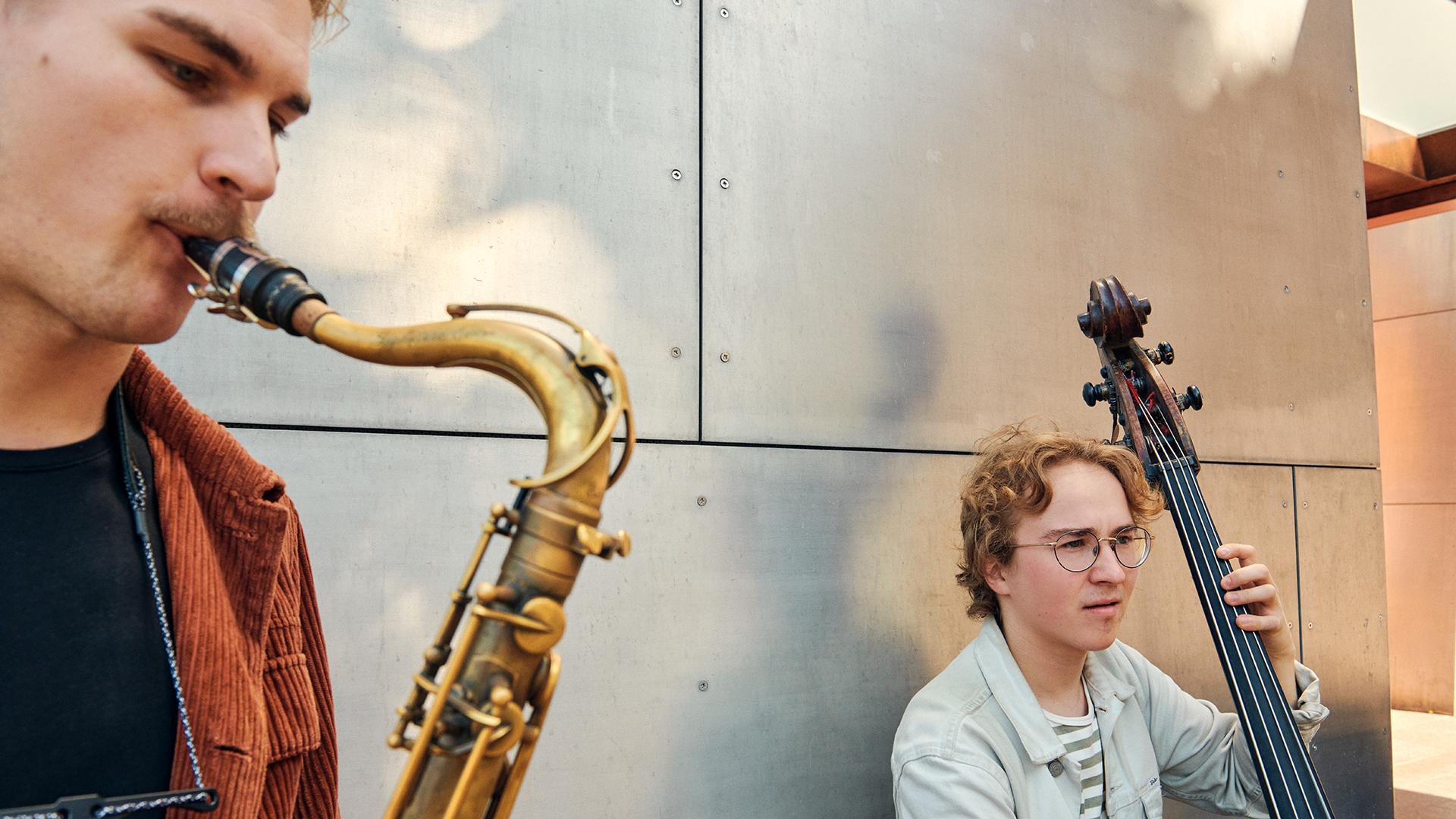
reeds: play within shared authority

Catherine Lee

I. Introduction

reeds is a site-specific collaborative work inspired by the soundscape of Newfoundland, Canada. The work unfolds as an equal partnership between composer Emily Doolittle, dancer Camille Renarhd and the musicians of the Umbrella Ensemble: clarinettist Louise Campbell, bassoonist Alexandra Eastley, and the author on oboe. The 36-minute score for reeds is based on sounds heard in and around Oxen Pond, throughout the course of a year. Many of the sounds, such as birdsong, are difficult for humans to understand and appreciate due to pitch, speed, and volume. By slowing down and amplifying certain aspects, composer Emily Doolittle “translated” these sounds into instrumental songs that are more readily understandable by human listeners. The performers’ movements draw inspiration from the music and the site and demonstrate the existing variety and possibilities of movement in nature. The cumulative effect of reeds is one of a shifting magnifying glass that illuminates the interesting, beautiful, and unexpected sounds and movements that we might ordinarily overlook.

Throughout this article, I speak from my perspective as a performer and address the collaborative process as it unfolded during our preparation for the work’s premier performance at Oxen Pond on July 10, 2010. I will also elaborate on some of the practical issues that helped to define reeds. The development of the work occurred in three interwoven stages: first, the development of the score; second, the integration of movement and music; and finally, the integration of the site, Oxen Pond. The acceptance of shared authority is central to reeds, furthermore it would have been impossible to realize without voicing the relationships co-existing within and between the composer, score, performers, audience and the site.

II. The Collaborators

The collaboration reeds grew from my desire to develop a project for the Sound Symposium XV, an international festival of new music and performance art that is held biennially in St. John’s, Newfoundland, Canada. The festival provides artists of all genres with the opportunity to explore new ideas and directions in music, visual and performance art. 

I first approached Canadian-American composer Emily Doolittle, whom I have known for many years. On June 17, 2009, we met in Seattle, Washington, to discuss the possibility of creating an interdisciplinary site-specific collaboration that would encourage all involved to experience a particular site in a new way.

Emily Doolittle is currently Assistant Professor of Composition and Theory at Cornish College of the Arts in Seattle. Her doctoral research focused on the relationship between bird and other animal songs and human music, a field in which she continues to be active. During 2009, Emily spent two months learning about animals’ acoustic communication at St. Andrew’s University, Scotland, learning both what scientists know and how scientists think about animal songs. Currently, Emily is interested in studying birdsongs from both a scientific and a musical perspective.

As a dancer and choreographer, Camille Renarhd is an incredibly sensitive artist who uses her movements to embody sound and subtle energies. She develops movement primarily through improvisation and has collaborated on many site-specific works. Camille’s background was immensely helpful in looking for movement possibilities within the score and the site and in creating unity between all the performers.

The Umbrella Ensemble is a wind reed trio featuring emerging Canadian musicians Louise Campbell, clarinet, Alexandra Eastley, bassoon, and the author on oboe. The ensemble, formed in 2005, grew from the three members’ desire to establish a creative “umbrella” under which they could explore mutual artistic interests. Each member brings diverse interests and talents to the ensemble. Louise Campbell is active as a classical and contemporary musician and has an interest in styles ranging from swing and klezmer to current explorations in free improvisation and collaborations with artists in dance and film. Alexandra Eastley is Principal Bassoon of Winnipeg Symphony Orchestra in Manitoba, Canada. As an orchestral soloist she brings fine attention to the subtle details of the printed score in order to realize the intent of the composer. I have performed on oboe and English horn in orchestras and avant-garde settings. I have a real interest in how improvisation can be used to develop the performer’s voice while at the same time building a relationship with the audience and focusing in on music as an experience shared by all.

The diversity in our backgrounds and working methods provided us with a wide range of perspectives but also required that we all learn to work in new ways, which at times could be frightening. Furthermore, we were geographically challenged, as our lives were spread out across North America. Emily and I live in the Pacific Northwest, (Seattle, Washington, and Portland, Oregon, respectively); Alexandra lives in Winnipeg, Manitoba; and Camille and Louise live in Montreal, Quebec. Though reeds did not rely heavily on technology, its development was facilitated by the many ways that we can now communicate and share ideas. This interaction was pivotal in developing a sense of group and in building trust and cohesion between the collaborators.

III. Development

Oxen Pond is part of the botanical gardens at the Memorial University of Newfoundland in St. John’s. The gardens are very beautiful and peaceful; though they cover 110 acres, they maintain an intimate feeling and are not overly groomed or stylized. The gardens contain five rustic trails that represent the plant habitats native to Newfoundland, such as freshwater, two kinds of wetlands, boreal forest, and Newfoundland barrens (Memorial University of Newfoundland Botanical Garden n.d.). 

On July 6, 2009, I visited the gardens to look for potentials of the space. While walking along the trails, I made detailed notes of the architectural objects, landmarks, sight lines, ground cover, temperature, wind speed, distances between possible sites, and soundscape, including inherent sounds such as the rustling of branches, footsteps on the paths, and the presence/absence of birdsong on different trails. I was looking for possibilities of integrating the performers into the landscape while at the same time allowing space for an audience without creating a formal stage space. This information was very important as it allowed us to begin to work remotely on integrating sound, movement, and site.

a) Development of Score

Once it was decided to set reeds at Oxen Pond, the question arose of how to depict a space. Emily had the idea to demonstrate the soundscape by using the songs of the birds that are found in and around Oxen Pond throughout the year. Emily researched the habitats of the resident birds and the months each species was the most active. She contacted two local bird-watchers, Dave Fifield and Jared Clarke, who provided her with lists of which birds you could expect to find at Oxen Pond in each month. Using these lists as a guide. Emily listened to recordings of the respective birdsongs and chose particular birds and sounds to base each movement of the piece on. During this process Emily used computer processing to slow down the songs to a tempo that allowed her to understand them. [1] Emily then chose the instrument (oboe, clarinet, or bassoon) that best represented the character of each birdsong and transposed the song to the appropriate register. Throughout, Emily was guided by her instinct, finding what sounded the most “musical” to her while at the same time maintaining the distinct character of each particular birdsong. [2]

“When birds sing, it is often very high or very fast, so I have slowed down the song and brought them down a few octaves so you can really hear them. And there are some notes birds sing that do not quite fit into our scales, so I have pushed them around so they do fit into our scales. But basically there is no new material that I have added that is not taken or inspired directly from birdsong.” [3]

The score for reeds consists of fourteen movements that outline the yearly cycle of sounds heard around Oxen Pond. “reeds begins with the cacophonous chorus of summer songbirds resident in July and then follows the changing soundscape of the year, exploring the sounds of waterbirds, migrating geese, the nearly silent stillness of the winter, and spring peepers, before returning to songbirds in full song” (Doolittle & Lee 2010) at the end of the piece. The compressed timescale, of 36 minutes, allows all involved to sense the seasonal comings and goings of each species. Two movements, Songs of Wing and Winter Meeting, are through-composed; three are short silent interludes; and the remaining nine movements use a time line to establish the structure. Conventional notation is used throughout, and each musician is required to play a recorder and a drum as well as their respective instrument.

In a score of this style, the composer gives more control over the final product to the performers as the choices we make define the overall formal structure. During the development of the score, the musicians discussed with Emily ways that we would be comfortable incorporating improvisational aspects into the score. As the score developed, Emily sent the musicians recordings and compositional sketches, giving us the opportunity to familiarize ourselves with the birds, sounds, and songs and to give feedback on technical issues such as the most effective ways to include extended techniques for our respective instruments. Our interaction helped to develop the collaborative relationship and to build a sense of trust.

The first movement, Summer Music, is structured around a time line (Figure 1) that allows interaction between the performers, the soundscape, and the site. Each musician is provided with a selection of songs and interjections; some are instrument-specific, and others are played by two or more instruments. Together, the songs and interjections create a body of melodic materials for the musicians to draw on throughout the movement. The songs fall into two forms: Figure 2 is an example of songs that are written out with a clear melodic and rhythmic structure (the winter wren birdsong is specific to the clarinet). Figures 3 and 4 show songs with choices: in this form, the musician makes decisions about the structural form of the song itself, deciding which motive to play and in what order. In the case of the American robin, Figure 3, the musician is invited to improvise similar motives. Short interjections, such as in Figure 5 (common yellowthroat) and Figure 6 (pine siskin) create a backdrop over which the longer songs are played.  The interjections are readily recognisable and were often used to create interaction between the performers as well as to provide cues during the performance. Throughout Summer Music, the choice of songs and interjections to be played, as well as when and how they are used, is left up to the discretion of the musicians.

I. Summer Music

July 10 – September 10 (0"-6'00")

Staging: Musicians should be spread out in different locations in front of and beside the audience, hidden behind trees or other environmental features.

Music: Each instrument has been given a collection of “songs” and “interjections,” labeled “s” and “i” respectively. Play according to the following time line:

Lee_figure_1_shrink.png

Figure 1: Doolittle, Emily. reeds, performance notes. [4]

Lee_figure_2_shrink.png

Figure 2. Doolittle, Emily. reeds, Summer Music.

Lee_figure_3_shrink.png

Figure 3: Doolittle, Emily. reeds, Summer Music.

Lee_figure_4_shrink.png

Figure 4: Doolittle, Emily. reeds, Summer Music.

Lee_figure_5_shrink.png

Figure 5: Doolittle, Emily. reeds, Summer Music.

Lee_figure_6_shrink.png

Figure 6: Doolittle, Emily. reeds, Summer Music.

Once the musicians had the score, discussions took place amongst us about the interpretation of phrasing and technical issues of the birdsongs that we had in common. For example, the American robin is played by both the clarinet and the oboe; it calls for the instrumentalist to incorporate flutter tonguing, glissandos, multiphonics, and tremolos. As these effects are implemented in different ways with differing results on our respective instruments, we decided to strive for realizing the underlying gestural effect, therefore allowing our respective birdsongs to sound similar but at the same time distinct from each other. 

b) Integration of Movement

After the score was developed, we began to focus on the integration of movement, which happened in two stages. The first was finding movement from the score and the landscape. Camille thought of herself as a shaman-like entity using her movement to create visibility of land and sound. [5] The second stage was creating the visual effect from the perspective of the audience and integrating the movements of all the performers with the landscape. 

Camille and Louise began going for silent walks on Mount Royal, a large park in the middle of Montreal. Camille began to integrate instrumental sounds by working with recordings of each of the musicians playing long tones and some of our respective “translated” birdsongs. Camille also did extensive video research of the birds, their movements, and their habitats. Louise and Camille created improvisations on the musical material contained in the score so that Camille could begin to develop materials for her movement. At the same time, in Portland, Oregon, I began to integrate nature and movement by going for silent walks, viewing videos of the birds and their habitats, and drawing on resources such as Sudden Music by David Rothenberg (2002). [6]

On June 20, 2010, three weeks before the premier, Louise, Camille, and I met in Montreal to workshop reeds. We quickly found that it was imperative that we begin each day with simple warm-ups (shiatsu, yoga, Qigong, or breathing) and then move on to movement exploration exercises (incorporating authentic movement and sound) before making longer improvisations with sections of the score. Working in this way had many benefits, including building a sense of cohesion between the three of us, allowing each of us to develop our personalities as performers, and helping to develop materials that could later be drawn on. 

Throughout this process, we all had to be flexible, as each of us was incorporating new ways of learning and interacting. For example, I had to let go of my sound; not worry about playing exactly what was on the page but rather the gestures and textures; and become familiar with incorporating improvisation with sound and movement at the same time. Our rehearsals resembled a distillation process with movement and sound possibilities. We extended sections so that there was time to develop ideas. For example, creating a 30-minute improvisation on the musical ideas from one particular movement in the score. This allowed us time to play and to let our creativity and imaginations lead us. Out of the longer improvisations, we would perhaps come up with one or two ideas that we would then further refine by making another improvisation. We began to embody the materials as we created a shared vocabulary of movements, gestures, and sounds built on interaction and translation. This was facilitated when Camille integrated sounds of some sort and Louise and I integrated movements. 

c) Integration of Site

In St. John’s, all five of us were finally together in the same place, and our focus shifted to the integration of Oxen Pond as an equal partner. We began walking through the gardens, as we experienced the diversity in them we looked for ways to incorporate a variety of sites around the pond and to guide the audience through the space. This particular performance would be, in essence, a sort of nature walk that we could use to highlight the surroundings and the movements and sounds contained within it.

As luck would have it, many of the sites where we set certain sections had resident birds of the variety we were depicting. For example, we set Water Dance, movement III, in a marshy area where we were happy to find a waterbird population. The path where we transitioned with Drumming, movement VI, had a resident Ruffed Grouse. And our final site, where we played Peepers, movement X, contained the garden’s frog pond.

The overall shape of the score was influenced as we developed the transitions between sites and created the overall formal structure. How we played each movement became directly influenced by the soundscape of Oxen Pond: We realized that we needed more silence, so that there was space for the site to sound. The sounds of the wind in the trees and bulrushes, footsteps on the gravel, water lapping against the shore, became recognized as an active part of our sonic world that we could interact with. The white- throated sparrow, Figure 7, was one bird that was particularly vocal, and one of the only birds that all the musicians played in real time, making its song immediately recognizable. In some ways this birdsong became a link between the performers and the site, and similar to the way that Camille incorporated sounds of water, gravel, and clapping with her movements, it increased the sense of play. These sounds became part of a common vocabulary that was easily accessible to all.

Lee_figure_7_shrink.png

Figure 7. Doolittle, Emily. reeds, Summer Music.

Following is a listing of the original score order for reeds (Doolittle 2010), including the birdsongs heard in each movement and their instrumentation.

Movement I. Summer Music (July 10 – September 10): Golden-crowned Kinglet (ob, cl), Pine Siskin (ob, cl), Common Yellowthroat (ob, cl), Yellow Warbler (ob, cl), White-throated Sparrow (ob, cl, bssn), Common Grackle (ob, cl, bssn), Dark-eyed Junco (bssn), Northern Waterthrush (bssn), Fox Sparrow (ob, cl), Winter Wren (cl), Pine Grosbeak (ob), American Robin (ob, cl, bssn), Purple Finch (bssn), Tree Swallow (bssn)

Movement II. A Hermit (September 11 – October 10): Hermit Thrush (ob, cl)

Movement III. Water Dance (October 11 – November 10): American Bittern (bssn), Common Loon (ob, cl), Spotted Sandpiper (cl), Greater Yellowlegs (ob)

Movement IV. Songs of Wings (November 11 – December 10): Canada Goose (ob, cl, bssn)

Movement V. First Interlude (December 11 – December 17): (silence)

Movement VI. Drumming (December 18 – January 17): Ruffed Grouse (all drums)

Movement VII. Second Interlude (January 18 – January 24): (silence)

Movement VIII. Winter Meeting (January 25 – February 2): Black-capped Chickadee (ob, bssn), Bald Eagle (cl)

Movement IX. Third Interlude (February 25 – 28): (silence)

Movement X. Spring Peepers (Not native to Newfoundland, but introduced) (March 1 – 31): Spring Peepers (all soprano recorders)

Movement XI. Songs of Wings (coming back!) (April 1 – 20): Canada Goose (ob, cl, bssn)

Movement XII. Bright, Open Eyes (April 21 – May 10): Herring Gull (ob, cl, bssn) 

Movement XIII. A Hermit (still alone) (May 11 – May 31): Hermit Thrush (ob, cl)

Movement XIV. Summer Music (once more!) (June 1 – July 10): same songs and interjections as Summer Music I. 

In order to incorporate the site of Oxen Pond for the premier performance on July 10, 2010, we made some changes to the structure of the score. The changes described below were made for this particular performance and would not necessarily occur in another performance. 

We incorporated three transitional walks to traverse the distance between the four sites: two shorter walks, between Summer Music (I) and A Hermit (II) and between A Hermit (II) and Water Dance (III); and a longer transitional walk that integrated whistling and movement play among the performers that resembled the flocking of birds, between Water Dance (III) and Songs of Wings (IV). First Interlude (V) and Drumming (VI) became a moving transition up to the final site during which the performers highlighted stones, wooden posts, and other features along the path by tapping the rhythmic pattern of the ruffed grouse call. We omitted A Hermit (still alone) (XIII). Finally, Songs of Wings (coming back!) (XI); Bright, Open Eyes (XII); and Summer Music (once more!) (XIV) became very interwoven and seamless, building to a climax at the end of the work.

IV. Audience

On the day of the premier, July 10, 2010, the audience of seventy people was led by Emily along approximately one kilometer of trails to four different sites. As they progressed, their awareness was brought to the sounds created by drops and splashes of water, the texture of the trees, the sound of the wind, and footsteps on a gravel path. The silences of the movements set in the winter months allowed all to bring our awareness to the shifting soundscape. The transitions between sites allowed the musicians to highlight the sounds created by natural objects along the side of the path. The traditional concert setting was once again challenged as the work closed. The final site was a clearing surrounded by trees and a frog pond where the musicians stood in an antiphonal configuration surrounding the audience with Camille in the centre. As the musicians passed off sound materials, the audience was not sure where they should focus their attention: on the musicians or on Camille dancing. By playing with their expectations, we encouraged their awareness to be brought to the larger site of the botanical gardens.

V. Conclusion

reeds is a collaboration between six equal voices that encourages all who take part to develop a deeper awareness of their surroundings by highlighting sounds and movements that usually go unnoticed. It exists in the moment as we experience the numerous interactions and relationships that coexist between the shared and shifting authority of score, performers, audience, and the site of Oxen Pond and its many dimensions. Our hope for the future is to use the score as a skeleton that can be filled with other melodic materials, determined by geography and time of year, to reflect numerous landscapes and soundscapes.

A short video of excerpts from reeds can be found at:

http://www.vimeo.com/17538091

password: reedsvideo

Notes

  1. Emily used the sound-editing program Audacity to reduce the speed of the birdsongs so that sounds and pitches not easily recognizable to the human ear became audible.
  2. Emily Doolittle, email correspondence with author, August 18, 2010.
  3. Transcribed from video of Emily introducing reeds on July 10, 2010.
  4. All figures reproduced from Emily Doolittle’s (2010) unpublished score, with permission of the composer.
  5. Camille Renarhd, personal conversation with author, September 7, 2010.
  6. We each used many resources a few are listed in the bibliography.

Bibliography


Ackerman, Diane (1999). Deep Play. New York: Vintage.

Doolittle, Emily (2010). reeds. Unpublished score.

Doolittle, Emily & Lee, Catherine (2010, July). reeds. Program notes for the Memorial University of Newfoundland Botanical Garden performance of reeds, Sound Symposium XV, St. Johns, Newfoundland, Canada.

Elliot, Lang & McGuire, Bob. Ruffed Grouse Drumming (video). Retrieved May 18, 2010 from http://www.youtube.com/watch?v=MVfiIp3QGs4

For the Visitor, Memorial University of Newfoundland Botanical Garden. Retrieved November 21, 2010, from http://www.mun.ca/botgarden/about_garden/.

Hahn, Tomie (2007). Sensational Knowledge. Embodying Culture through Japanese Dance. Middletown CT: Wesleyan.

Lee, Catherine (2010, September). play: within shared authority. Paper presented at The Embodiment of Authority: Perspectives on Performances Conference, Helsinki, Finland.

Oliveros, Pauline (2005). Deep Listening: A Composer’s Sound Practice. Lincoln NE: iUniverse.

Rothenberg, David (2002). Sudden Music: Improvisation, Sound, Nature. Athens: University of Georgia.

Schafer, Murray R. (1994). The Soundscape. Our Sonic Environment and the Tuning of the World. Rochester: Destiny Books.

Sibley, David Allen (2000). The National Audubon Society: The Sibley Guide to Birds. New York: Knopf.

Winter Wren (sound), All About Birds, The Cornell Lab of Ornithology. Retrieved April 30, 2010, from http://www.allaboutbirds.org/guide/Winter_Wren/sounds.